January 2026
Hello Happy New Year!
I hope you had a great holiday season. We had a nice little Christmas this year and spent a couple days in Nashville for New Years.
I am sorry I missed last month's enewsletter. On December 10, I had surgery so I was a little preoccupied. Every day gets better and the important thing is the tumor is gone and I am riding and working. I sincerely appreciate everyone's prayers for continued healing. So that I can focus on the healing plan, I am doing more saddle fittings and lessons at home this year and Baley is taking on most of the traveling.
Did you know that poor saddle fit can cause a horse to lose shoes?
The other day I was working with a rider trying saddles. She mentioned that she was having trouble keeping shoes on her horse. We all know how frustrating and inconvenient it is to lose a shoe. I didn't think too much of it until she started riding in her saddle and her horse was forging like crazy. It was clear to see how the shoes were coming off.
Then when we changed saddles, there was no forging because we freed up the shoulders. When a saddle is pinching the withers or blocking the shoulders the length of stride is restricted. Every time the horse steps forward the shoulder goes back under the front of the saddle. The tree must match the horse's width and angle to allow the shoulder to freely pass under the front of the saddle.
Forging is when the back foot comes up and catches the front foot. When we switched to a saddle with more shoulder freedom, he stopped forging and his over step increased by about 4".
Shoes can be replaced and usually no real harm is done but there can be more long term permanent damage done to the tendons, ligaments and tiny little fragile bones in the feet when the horse's shoulders are restricted.
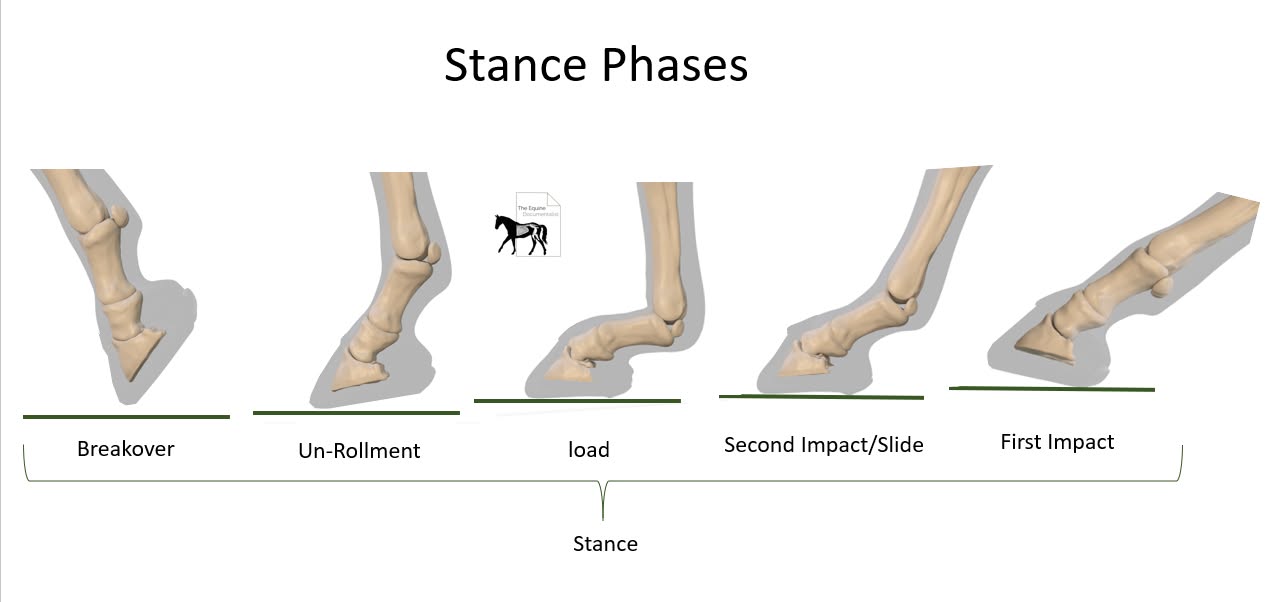
When the foot lands, it lands on the heel first. The shock is absorbed down through the joints as the toe rolls over and pushes off for another step. If the shoulder is restricted the horse's stride will be shortened causing the foot to land more on the toe than on the heel. Horses that land on their toes trip and stumble and develop lameness issues and it can all be caused by poor fitting saddles.
Check out this picture of the phases The Equine Documentalist posted on their Facebook page.
Don't forget saddle fit should be checked at the very least once a year. I tell everyone 6-12 months because a lot can go wrong in 12 months. Since the changes happen very gradually, you might not even notice that anything is wrong until we refit it.
YOU TUBE FIT RIGHT SADDLE SOLUTIONS
Is Your Saddle Restricting Your Horse's Shoulders
I have mentioned this video many times lately so want to share it here again. It was a dissection clinic Larry and I attended back in PA. In this video she shows how the cartilage on the shoulder can get damaged by the saddle. She talks about how the shoulder goes way back under the saddle when the foot goes forwward.
I see a lot of posts about putting the western saddle behind the shoulder yet in their pictures the saddle is not behind the shoulder. In this video she shows the thickness of the trapezius muscle which makes it difficult for us to know exactly where the shoulder ends and where the cartilage starts.
NOTE: Some of the gaited horses carry their saddles further back which is totally fine as long as they have room for it and the rider is over the horse's center. We'll talk about that next time.
I believe the western saddle tree needs to have a little flare in the front and the rear to keep pressure off the shoulder and lumbar, because most of the time it is impossible to have a western saddle sit behind the shoulder and still keep the rider over the horse's center. An english saddle does go behind the shoulder and end before the lumbar because of the design of the tree which is also much shorter than western. Check out the video.
Thank you for giving me the opportunity to help you and your horse with your riding goals.
TTYS & God Bless,
Terry Peiper, Fit Right Saddle Solutions
“Spreading the word about proper saddle fit & how it affects our horse's behavior, performance & ultimately the health of horse & rider.”
Past enewsletters
